Tuesday, 2 November 2021

Signs Gold Coast Boom No Flash in Pan

Crunch the numbers on high-rise projects popping up across the booming Gold Coast and it’s a wonder the city’s developers are not complaining of chronic sore necks.

It’s not so much the constant craning of their heads to survey their towering creations that would be the cause, but rather the portentous reflex of repeatedly looking over their shoulders.

Given the notoriously volatile reputation of the Gold Coast’s property cycles, who could blame them.

Surging approvals for apartment towers, new benchmark prices for beachfront development sites, frenzied off-the-plan project sell-outs, skyrocketing building costs—it all seems ominous.

After years out in the cold following the global financial crisis, the city’s development sector has aggressively come back on the boil during the past 18 months, begging two questions: has the latest boom hit its peak and is the Gold Coast about to take another dive?

Truth be told, with borders yet to fully reopen and the global impact of the pandemic still playing out, nobody really knows for sure.

But according to developers and property experts who spoke with The Urban Developer, the market fundamentals are holding strong and there are no signs of an imminent bust or even a significant simmering.

In fact, flying in the face of any instinctive foreboding, there is the very real possibility of a further strengthening in the market.

“When people can get to Queensland again, I think it will accelerate,” Sherpa Property Group chief executive Christie Leet says.

“I imagine there will be an awful lot of people who will choose not to live in Sydney and Melbourne … and I think we’re just starting to see that and we’re in for a good run going forward.”

Nevertheless, Leet says regardless of the prospect of doubling down on a looming migration tsunami, he is still not prepared to bet the family home on long delivery projects.

He says development site prices nudging $20,000 per square metre and beyond along some areas of the beachfront are “towards the top end, well and truly”.

“There’s a fair argument that we might have hit a peak,” Leet says. “But there’s still plenty of people out there buying tower sites that are going to take three or four years to develop.

“No doubt not all those are going to get off the ground. Even if you can get them sold, you’ve still got to get them funded and, most importantly, you’ve got to get them built.”

Gold Coast

▲ We’re in for a good run going forward: Sherpa Group’s Christine Leets, whose The Perspective 202 Bilinga, is pictured. 

Opportunities, value remain

Leet says, however, as a developer—notwithstanding the escalating development costs—the opportunities and value are still there.

“You can still drive up and down a street and say ‘Geez, I’d love to get a hold of that old shack and really do something quite special’.

“We just bought a new site and we’ll probably buy another one before Christmas … but certainly, from our point of view, we’re a bit risk averse in terms of taking on projects that have more than a two-year delivery cycle.

“We think things will be okay until 2023 and after that there’s still a bit of a question mark … but if there’s anything that’s going to drive the market past that it’s going to be that net interstate migration and international migration.”

At last count, there were more than 50 residential projects with an estimated investment value of $4.8 billion under construction and with firm pipeline commitments.

In the first three months of this year, approvals ramped up by 33 per cent and the Gold Coast recorded almost $800 million in new apartment sales, just $112 million shy of the total sales in 2020.

A very different boom

“It’s a very different boom—I’ve stopped speculating,” CBRE Gold Coast director Mark Witheriff says. “Obviously, in the background, there’s a global pandemic going on … so, who knows?”

But he says unlike previous booms driven by massive investor sprees and developer over-exuberance—ultimately leading to market oversupply— this time around the Gold Coast is “not getting carried away with itself”.

Gold Coast

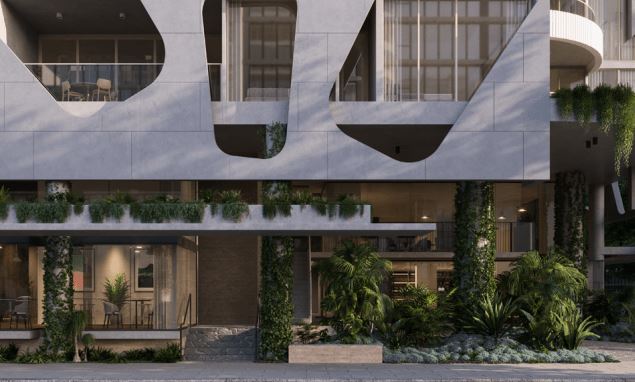
▲ Lacey Group’s The Monroe at Jefferson Lane in Palm Beach on the southern Gold Coast. 

Instead, a seismic paradigm shift in population created by Covid is at play and Witheriff believes it will be the catalyst for “real” and sustained growth.

“The last boom was driven by money being freely thrown around … it’s not the same now. We are growing because people are moving here from the higher density cities and if they’re not here now they’re planning to be here.”

He likens the city’s pandemic-induced boom to the upshot from Queensland’s abolishment of death taxes in the late 1970s by then-Queensland premier Joh Bjelke-Petersen.

“There was a flood of money and people that came over the border and I suspect this pandemic is going to have the same effect.”

As for the city’s soaring development site prices, Witheriff says: “There’s still value to be had and there’s strong demand and requirement for accommodation—and we haven’t even seen the borders reopen yet”.

“Subject to something globally changing that causes major issues, we should have a period of sustained growth but not silly growth, not out-of-control growth,” he says.

“In 2022, I don’t think we’ll see the price growth that we’ve seen in the last 18 months but we’ll certainly still see population growth and development continuing at a reasonable pace.”

Of the people moving interstate, almost a third have been upping stumps to come to Queensland, ABS data shows.

According to the latest Commonwealth Bank Regional Movers Index—despite Sydney being in lockdown the entire September quarter and Melbourne for two-thirds of it—net migration to regional areas rose by 14 per cent.

The Gold Coast remains the most popular destination, welcoming 11 per cent of all capital city residents who moved to regional areas during the September quarter.

Gold Coast

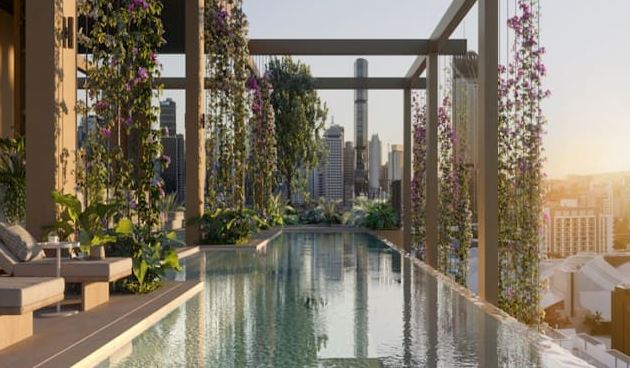
▲ A render of the pool area at Royale Gold Coast at Northcliffe Terrace. 

Witheriff also expects that while most of the development focus so far has been on luxury owner-occupier product, other “markets within the market” will start to get stronger—in particular, the investor market.

Return to affordability on the way

“There has to be a push back to the affordable,” he says. “There is a shortage of accommodation throughout the city. The residential vacancy rate has hit historic lows. We need more apartments and homes than we can currently rent.”

Real Estate Institute of Queensland data indicates the city’s vacancy rate plunged to 0.6 per cent in the March quarter, the lowest level on record.

Lacey Group director Adam Lacey says the “missing middle” will inevitably be on the radar for the city’s development sector going forward.

“Affordability is getting worse and it’s pushing a lot of people out,” he says.

But as he well knows, it is becoming increasingly difficult for development sites to be acquired and for product to be delivered that can feasibly meet that price point.

“We’ve got two projects in delivery mode and are starting to hunt around for more sites to fill the pipeline but acquisitions at the moment are a very challenging scenario.

“It has been pretty much a perfect storm up here and a lot of the southern developers have now got their eyes on the Gold Coast.

“We’ve had a massive influx of those guys and, as you can imagine, more competition has just raised things dramatically … sites have doubled in price but compared to Sydney and Melbourne they are still cheaper and that’s a huge driver.

“So, at the moment I can’t see anything slowing us down for at least another 12 to 18 months.

“All the buyers we’ve had so far primarily have been buying off-the-plan sight unseen. Once the restrictions are lifted around Christmas time and people can actually get up here and see the properties, and once international borders open up … it’s just going to be another wave.

“Typically, the Gold Coast has been boom-and-bust and runs that cycle but it feels this time around there’s more substance to it and if there are going to be any adjustments, I don’t think we’re going to see the same sort of highs and lows.

Gold Coast

▲ Iris Capital’s planned Gold Coast debut, a twin-tower development at Broadbeach. 

“Also, because of what has been happening globally over the past 18 months I think the Gold Coast is now being taken a bit more seriously as a city. It is becoming a far more attractive proposition to people and they want to do business and live here.”

Smaller projects, lower volatility

Urbis Gold Coast director Matthew Schneider says there is also much less volatility in the city’s property market because the scale of the projects is much smaller.

“We’re not in a situation now where the strength of the property market is dependent on a half dozen large-scale projects, each taking four or five years across multiple cycles to build and carrying a much higher value and risk profile.

“That shift to smaller scale projects, to boutique apartments, I think is the reason we’ve seen that volatility come out of the Gold Coast market and a much more stable set of circumstances.

“So, if you look at the drivers of those booms and busts previously it’s hard to see the fingerprints of those forces at the moment—it’s quite a different cycle.”

Schneider says notwithstanding the current strength of the market, the city’s apartment supply is sitting at only four to five months and the 4500 dwellings being delivered per annum across the Gold Coast is still well short of the 6000 dwellings required to meet population forecasts.

“There’s some really positive forces over the foreseeable future,” he says. “We have very strong conditions in terms of demand for product, there are still sites available and, yes, construction costs have escalated but so have sales revenues.

“As well, internal and international borders are only just starting to open up and so, given there is still such strong value on the Gold Coast relative to other markets, we can expect to see demand continue and perhaps even strengthen.

“That, in all likelihood, will get us to mid-decade and by then we should be seeing the Brisbane Olympics shadow starting to cast its positive effect.

“So, if people are looking over their shoulders at the moment it’s really just because of that dark cloud of uncertainty being felt everywhere … but where there doesn’t seem to be much uncertainty is that there are strong levels of demand on the Gold Coast for the foreseeable future.”


Article Source: www.theurbandeveloper.com


from Queensland Property Investor https://ift.tt/2ZHXDLn
via IFTTT

Social Bonds Built 4900 Affordable Homes Last Year

Australia’s fledgling social and sustainability bonds market is taking flight with $805 million in issuances by the National Finance and Investment Corporation in the past year oversubscribed by at least two times.

The continued growth in the investor base, both locally and from overseas, reflects the emergence of social and affordable housing as a recognised investment asset class.

More than half of the new institutional investors were from offshore.

Funds raised from the issuance of the government-guaranteed bonds are used to finance or refinance housing projects that have positive social and green outcomes.

According to the latest National Housing Finance and Investment Corporation (NHFIC) Social Bond Report, its 2020-21 issuance supported more than 4900 dwellings.

About two-thirds (65 per cent) of the community housing provider (CHP) loans funded by the three bonds underpinned new housing supply.

The bond issuance—including NHFIC’s first sustainability and longest tenor bond (15 years), and first floating rate note—also provided nine CHPs with an estimated $161 million in fee and interest savings, through longer tenor and lower-interest loans.

NHFIC chair Adrian Harrington said its social bonds now accounted for more than a quarter of all Australian dollars issued.

“Our bond program has attracted close to $2 billion from more than 60 institutional investors,” he said. “This makes us a leading issuer of social bonds in Australia.”

He said the issuance of NHFIC’s first sustainability bond had helped attract new investors to support sustainable, social and affordable housing across the country.

“The strong support we have received from the institutional investors bodes well for social and affordable housing becoming a more established investment asset class in Australia,” Harrington said.

The CHPs supported by the bonds issued by NHFIC during the 2020-21 financial year included Building Communities (Vic), Common Equity Housing Limited, Foundation, Housing Choices SA, Housing Choices Tasmania, Mission Australia, Pacific Link, SGCH Group and Unison.


Article Source: www.theurbandeveloper.com


from Queensland Property Investor https://ift.tt/2ZKlr0p
via IFTTT

Storm Clouds Gather as Perth Value Drops

The winds of change appear to be sweeping across property prices as the first capital city in Australia records a drop in monthly values—and experts predict there will be more cities to fall.

Dwelling prices in Perth fell 0.1 per cent, the city’s first drop in values since June 2020, according to Corelogic’s monthly hedonic home value index.

Brisbane, meanwhile, became the hottest property market in the country with growth at its highest rate in 18 years.

The other capital cities recorded gains, adding to what has been a unprecedented year for the property market with prices up 25.35 per cent, while Darwin has recorded mixed results in the past few months.

However, there were warnings from experts that storm clouds were gathering.

Australian house prices: October

Location Month Quarter Annual Median Value
Sydney 1.50% 5.24% 25.23% $1,071,709
Melbourne 0.99% 3.01% 16.37% $780,303
Brisbane 2.54% 6.50% 22.30% $642,097
Perth -0.11% 0.65% 16.37% $526,625
Adelaide 2.00% 5.86% 20.07% $543,265
Hobart 2.00% 6.66% 28.06% $526,625
Darwin 0.42% 0.41% 19.28% $490,236
Canberra 1.94% 6.18% 25.52% $864,909
Capitals 1.38% 4.41% 20.82% $771,264
Regional 1.87% 5.28% 24.29% $514,308
National 1.49% 4.60% 21.58% $686,339

^Source: Corelogic hedonic home value index for October 2021

AMP Capital chief economist Shane Oliver said they had revised their outlook to a 5 per cent increase in 2022 and a 5 to 10 per cent decline in 2023.

“Storm clouds are starting to gather for the property boom and we expect a further slowing in price gains ahead of falls from later next year,” Oliver said.

“Listings are on the rise, reflecting the end of lockdowns and high prices, and poor affordability is pricing more and more borrowers out of the market.

“A rotation in consumer spending back towards services as reopening occurs may reduce housing demand.

“Higher interest rate serviceability buffers and likely further macroprudential controls will likely slow borrowing, fixed mortgage rates are on the rise and the RBA is expected to start raising interest from late next year.”

House and apartment price changes

City House monthly House quarter Unit monthly Unit quarter
Sydney 1.6% 5.7% 1.2% 4,1%
Melbourne 1.0% 7.1% 1.0% 1.7%
Brisbane 2.8% 7.1% 1.3% 3.3%
Perth -0.1% 0.7% 0.2% 0.5%
Adelaide 2.2% 6.5% 1.0% 1.8%
Hobart 2.0% 6.4% 2.0% 7.7%
Darwin -0.2% -1.2% 1.6% 3.6%
Canberra 1.9% 6.4% 1.9% 5.2%
Capitals 1.5% 4.8% 1.1% 3.1%
Regional 1.9% 5.3% 1.6% 5.4%
National 1.6% 4.9% 1.2% 3.5%

^Source: Corelogic hedonic home value index for October 2021

Corelogic research director Tim Lawless said slowing growth conditions in October were a factor of worsening housing affordability, rising supply levels and less stimulus.

“Housing prices continue to outpace wages by a ratio of about 12 to 1. This is one of the reasons first home buyers are becoming a progressively smaller component of housing demand,” Lawless said.

“New listings have surged by 47 per cent since the recent low in September and housing-focused stimulus such as HomeBuilder and stamp duty concessions have now expired.

“Combining these factors with the subtle tightening of credit assessments set for November 1 and it’s highly likely the housing market will continue to gradually lose momentum.”


Article Source: www.theurbandeveloper.com


from Queensland Property Investor https://ift.tt/3pXm3uJ
via IFTTT

Monday, 1 November 2021

Gold Coast Housing Market Insights: October 2021

The Urban Developer’s latest Gold Coast housing market insights reveals the city’s property prices have increased by nearly $400 a day in the past year—jumping by more than 30 per cent in some suburbs.

This resource, updated periodically, will collate and examine the economic levers pushing and pulling the Gold Coast’s housing market.

Combining market research, rolling indices and expert market opinion, this evolving hub will act as a pulse check for those wanting to take a closer look at the movements across the market.

Gold Coast median property prices % change

Type Month Quarter Annual Median
All 2.0%▼ 6.4%▼ 26.7%▲ $727,219▲
Houses 1.6%▼ 6.2%▼ 28.6%▲ $886,747▲
Units 2.6%▲ 6.7%▲ 23.2%▲ $544,681▲

^Source: Corelogic – September 2021

While other housing market’s across the country saw declines in 2020 due to the pandemic, the Gold Coast, after a decade of moderate growth, has benefitted from the rise of working from home culture and lifestyle offerings.

According to Corelogic, the average Gold Coast house prices increased by 22 per cent between July 2020 and 2021.

The Gold Coast’s increase is now outpacing more established cities such as Adelaide, Darwin and Perth.

In the 12 months leading to March this year, the average price of new apartments increased by 23 per cent.

The rate of price growth has continued to gain momentum on the Gold Coast after reaching a peak in March this year, when values rose 3 per cent in a single month—a 15.4 per cent increase compared to March 2020.

The 2 per cent growth in dwelling prices in September was down slightly from the 2.3 per cent lift in August. Prices are now up 26.7 per cent across the year.

The current median value for dwellings is $727,000 advancing an additional $17,000 over the month of September.

A typical Gold Coast house is now worth $887,000, with a 1.6 per cent increase in September pocketing homeowners $25,000 across the month.

Over the June quarter, the median house price rose to a new record high, 18.2 per cent higher than the year before.

The median for a Gold Coast’s apartment is now $545,000 with many new buyers planning to split their time and lease their unit to holidaymakers while they are in the city, and spend part of their time working from home at the beach.

Buyers have also been lured by the Gold Coast apartment market’s switch from skyscrapers such as Q1 and Soul, both of which are more than 75 levels, to smaller projects featuring bigger apartments with more ameneties.

Gold Coast’s housing market: policy updates

Doubt on RBA rate hike plans

The central bank reiterated its view it will not increase the cash rate until actual inflation is sustainably within the 2 per cent-to-3 per cent target range and such condition would not happen before 2024.

RBA governor Philip Lowe said it was “difficult” to rationalise the market’s expectation that rates might rise in 2022 or 2023.

Frydenberg signals home loan crackdown

Treasurer Josh Frydenberg has given backing to regulators to crack down on high-debt home loans to reduce financial risks from record-low interest rates and surging property prices.

Analysts expect the council to announce new home lending restrictions before the end of this year.

Brisbane Olympics to push property market’s limits

Brisbane house prices will hit the $1-million median well before the 2032 Olympics with suburbs near venues tipped to move up to $3.9 million.

Meanwhile, prices on the Gold Coast and Sunshine Coast hit $792,000, up 18.2 per cent on last year, and $825,000 up 23.1 per cent, respectively.

What the experts are saying about the Gold Coast’s housing market

Dr Nicola Powell

Nicola Powell
Chief of Research
Domain

“Queensland has been ready for growth for so long, and while it has always been the spot for people to move interstate from Sydney or Melbourne, the pandemic has created a new environment for people to re-imagine what their life is.

“So, we’ve seen an increased volume of people moving from interstate in their prime working years, and while south-east Queensland has always been front of mind for retirees, that’s not the case anymore.

“It offers affordability and so, for some, they’ve been able to put a lifestyle dream into reality.”

Steven King Colliers Gold Coast


Steven King
Gold Coast Director
Colliers International

“It could be scary to see how many people do want to come to the Gold Coast.

“Covid has probably brought forward those plans many years, where they’re [buying] now as opposed to when they retire.

“That demand meant prices have got to go up, but the Gold Coast is still more affordable than some other places.”

Mark Witheriff Managing Director, Gold Coast Queensland


Mark Witheriff
Gold Coast Managing Director
CBRE

“Prime beachfront property up and down the Gold Coast, from the border to Main Beach, is very strong.

“There’s a real lifestyle change. They are looking for three bedrooms, some real comfort in them, whereas previously they were two-bedroom apartments and they were trying to get more in there rather than less.

“Now people are downsizing or coming up and wanting to live in these prestige apartment buildings rather than just a holiday. That’s the shift – bigger and better apartments.”

Stuart Legg Sales Associate RE/MAX Regency, Robina

Stuart Legg
Sales Associate
RE/MAX Regency

“For years I’ve probably run at about 5 per cent per annum for interstate buyers but now it’s 16 per cent.

“I think it comes back down to the fact that interstate buyers want something that will improve their lifestyle … and money goes a long way up here.

“I have also seen more younger buyers coming up and a few young professional couples—who would generally be chained to a CBD environment but [who] can now work from home—are buying acreage.”

Gold Coast housing market forecasts

ANZ similarly predicts at the national level Australian house prices will rise by a strong 17 per cent through 2021, before slowing to 6 per cent growth in 2022.

CommBank forecasts dwelling prices will rise 8 per cent in 2021 and 6 per cent in 2022, with house prices to rise 16 per cent in that time and unit prices by 9 per cent.

NAB has also upgraded its forecasts for dwelling prices—now expected to grow around 19 per cent in 2021 and per cent in 2022.

Westpac has upgraded its housing market forecasts, tipping house prices to lift by a further 5 per cent in the remaining three months of 2021 to be up 22 per cent for the year.

Gold Coast auction clearance rates

Week Clearance rate Total Auctions
Week ending 6 September 2021 66.6% 69
Week ending 13 September 2021 70.9% 89
Week ending 20 September 2021 74.5% 55
Week ending 27 September 2021 69.8% 83

^Source: Corelogic – September 2021

While Brisbane, Gold Coast and Sunshine Coast property markets are all unique, there are a few things they have in common and that is to do with what Queenslanders are looking for in a home: size, property type, property features and location.

According to Corelogic, year-on-year home sales have risen by 54 per cent in Queensland to be at the highest number of annual sales since 2004.

The greatest increase in prices over the year has been in suburbs along the future southern route of the Gold Coast light rail, according to the data, with the next stages to run from Broadbeach to Burleigh Heads and to the border via Gold Coast Airport.

Broadbeach-Burleigh recorded a 32.4 per cent rise in property values between August 2020 and August 2021 while Coolangatta jumped 32 per cent.

Nationally, turnover has been the highest in Queensland, with 6.8 per cent of the state’s properties transacting over the year to August.

Auction clearance rates are expected to continue at record high levels bolstered by demand from interstate buyers emerging from lockdowns alongside local buyers taking advantage of historically low interest rates.

Supply also remains tight with more people looking to buy on the Gold Coast than vendors looking to sell—leading to increased property prices.

Views for Surfers Paradise auctions are up 40 per cent while listings in Robina, Broadbeach, Southport and Sorrento are all up more than 30 per cent.

Gold Coast residential rental vacancy rate

City Vacancy rate Monthly change Vacancies Net change
Gold Coast 1.2% 0.1%▲ 494▲ ▲39

^Source: SQM Research – September 2021

Queensland’s rental crisis has worsened to a point where it is now more expensive to rent a house on the Gold Coast than in Sydney, and the chronic shortage of available properties could last for at least three years, experts say.

The median asking rent for houses on the Gold Coast has jumped to $766 a week as of September, compared with $702 in Sydney, according to recent SQM Research data.

Gold Coast house rents shot up by five per cent over the past three months with the city also collecting its greatest annual rate of growth—22.9 per cent—since records began in 2004.

Unit rents also rose 13.6 per cent over the year and 4.2 per cent over the quarter, the strongest rate of annual growth since 2007.

The pandemic-driven rush from Sydney and Melbourne into the state has sent Queensland’s rental market into uncharted territory, pushing vacancy rates down to their lowest levels since 2012.

House rents in Mudgeeraba rose 8.1 per cent over the past year to $600 per week with Clear Island Waters, on the Gold Coast, stealing the top-performing crown by suburb after the median house rent skyrocketed 30 per cent in a year to $949 per week.

Median house rents in the Ormeau-Oxenford region to jump 7.1 per cent over the past quarter to $525 per week, with units in the nearby Nerang region soaring by 7.9 per cent to $480 in three months.

Queensland building approvals 

Dwelling Approved Monthly % change
Houses 2234▼ -5.2%▼
Units 3516▲ 4.0%▲

^Source: Australian Bureau of Statistics – August 2021

New dwelling approvals have risen an unexpected 6.8 per cent in August, led by an uptick in apartments moving through the system at the fastest rate since March.

The national seasonally adjusted total of 18,716 dwelling approvals ended five consecutive months of decline and was bolstered by a 13.7 per cent resurgence in apartment approvals, data from the ABS indicated.

Strong demand for apartments was particularly evident in Queensland and Western Australia where population growth is driving demand for medium-density housing.

The number of units approved in Queensland and Western Australia were 33.2 per cent and 84.2 per cent higher in the 12 months to August 2021 than in the previous year.

Residential dwelling approvals have now increased by 33.7 per cent in the three months to August compared to the same time last year, with detached approvals up by 31.5 per cent and multi-unit approvals up by 38.1 per cent.

Residential alteration and additions approvals ticked up 10 per cent from July to the second highest level recorded, behind April of this year.

Queensland home loan lending indicators 

Type Aug 2021 ($bn) Monthly % change
New loan commitments for owner occupier housing $3.94 0.5%▲
New loan commitments for investor housing $1.85 13.4%▲
New loan commitments to first home buyers $2.53 1.6%▲

^Source: Australian Bureau of Statistics – August 2021

The relatively restriction-free states of Queensland recorded the strongest growth in investor demand this year, up 13.4 per cent over the month of August.

Investor loan commitments reached about $1.85 billion across the four weeks according to the latest Australian Bureau of Statistics lending indicators as buyers look to snap up a potential oceanfront property.

At $9.4 billion, investor loan commitments nationally across the month were at their highest level in dollar terms since April 2015, about the last time the prudential regular was forced to step in and cool the housing market.

The average owner-occupier home loan is up $76,000, or about 15 per cent, for the year, while the average dipped for most states in August.

The value of investor lending in August was almost double that of 2020. But in contrast to 2015, when investors made up about 50 per cent of the value of loan commitment, the present portion is just below 30 per cent.

But despite growing demand from investors, owner-occupier commitments remained elevated above long-run levels and totalled $21 billion over the reporting period.

Queensland interstate migration

State Arrivals Departures Net change
Queensland 28,500▼ 21,465▲ 7035▼

^Source: Australian Bureau of Statistics – March 2021

With a population of roughly 3.7 million, Queensland’s south-east is Australia’s fastest-growing zone.

The Gold Coast and south-east Queensland were direct beneficiaries of Victoria’s extended lockdown last year, with a dramatic population shift north.

Australian Bureau of Statistics data for June revealed Victoria’s population fell by 12,700 while the number of interstate migration to Queensland increased by 30,000, or 2 per cent.

Before the pandemic, Gold Coast city planners were working to a framework that the population would reach a million by 2041, delivering 6000 dwellings for approximately 15,000 new arrivals per annum.

Queensland’s population is now expected to surge by more than a quarter of a million people in the next four years, according to forecasts in the federal budget, as people continue to flood in from other states.

Additional forecasts suggest it will top 5 million by the middle of the next decade.


Article Source: www.theurbandeveloper.com


from Queensland Property Investor https://ift.tt/3GF14ml
via IFTTT

Brisbane apartment insights: What happened to Brisbane apartment prices over October?

Apartment values ended 2020 at $390,000. Now the median apartment value is $437,000, up 9.7 per cent year to date

Brisbane apartment values spiked 1.3 per cent over October, posting its second highest monthly returns of 2021, CoreLogic’s Hedonic Home Value Index found.

The continued growth sees Brisbane’s apartment values rise 3.3 per cent on a rolling quarterly average, following 0.6 per cent gains last month and 1.4 per cent growth over August.

Apartment values ended 2020 at $390,000. Now the median apartment value is $437,000, up 9.7 per cent year to date.

Trellis

Trellis 20 Edmondstone Street, South Brisbane QLD 4101

Brisbane’s rental increase has also been one of the highest in the country, up 2.3 per cent over the last three months, only second to Sydney where rents rose 2.4 per cent.

Overall Brisbane was the fastest growing market over October, with values up 2.5 per cent across the combined house and unit markets.

It was another month in Brisbane where the price gap between houses and units grew further. Houses saw 2.8 per cent gains, more than double the rate of growth for units.

“As housing becomes less affordable, we expect to see more demand deflected towards the higher density sectors of the market,” CoreLogic’s research director, Tim Lawless, said.

Bide

Bide 21 Longland Street, Newstead QLD 4006 

“House prices continue to outpace wages by a ratio of around 12:1,” Lawless noted.

“This is one of the reasons why first home buyers are becoming a progressively smaller component of housing demand.”

Lawless expects the flick to higher density to occur most prevalently in Sydney than anywhere else in the country. The gap between the median house and unit value is now nearly $500,000. In Brisbane it’s around $300,000. Melbourne’s house median was $731,000 after the 2.8 per cent October gains.

“With investors becoming a larger component of new housing finance, we may see more demand flowing into medium to high density properties,” Lawless added.

“Investor demand across the unit sector could be bolstered as overseas borders open, which is likely to have a positive impact on rental demand, especially across inner city unit precincts.”


Article Source: www.urban.com.au


from Queensland Property Investor https://ift.tt/3jWdXyV
via IFTTT

Beware of pedlars of supply side solutions to home affordability

One thing you can be sure of is that if house prices are soaring, governments will be holding inquiries into it. Unfortunately, the other thing you can be sure of is that nothing will come of those inquiries.

Why? Because their purpose is to express the government’s deep concern about the worsening affordability of homeownership – its heart-felt sympathy for young people struggling to buy their first home – not to tackle the problem.

Why? Because policy decisions made by governments – federal and state – over many years have rigged the housing market in favour of people who already own their homes and against those who’d like to own.

Why? Because the number of voting homeowners far exceeds the number of voting would-be homeowners. The established homeowners – and the industries that benefit from the rigged market, such as property developers and real estate agents – get shirty if they think their privileges are threatened.

Labor summoned its courage and promised to act against negative gearing and the deep discount of capital gains tax in the 2016 and 2019 federal elections but, since its shock defeat in 2019, its courage has deserted it.

Speaking of housing inquiries, as we speak Treasurer Josh Frydenberg has a parliamentary committee inquiring into “housing affordability and supply”. As its terms of reference make clear, it’s not actually about housing affordability, but really about blaming rocketing house prices on inadequate supply rather than excessive demand.

Why? Because, with a federal election fast approaching, its real motivation is to shift the blame for increasingly unaffordable house prices away from the feds and on to the states. Whereas most of the policies promoting demand for homeownership are under the influence of the federal government, most of the policies affecting the adequacy of the supply of homes are influenced by the state governments and their creature, local government.

When I wrote about the causes of rocketing house prices last week, I knew I was leaving myself open to attack because I focused solely on factors adding to demand and didn’t get to supply factors before I ran out of space.

True, no analysis of change in any market price is adequate if it doesn’t examine both sides of the market. So let me make amends.

The price of buying a home is an unreliable guide to the price of finding somewhere to live.

In simple economic theory, if the price of some item rises, the reason should be that demand has outstripped supply. Let supply catch up and the price should return to where it was. If the demand for homes rises by 100, build 100 more homes and the price should be unchanged.

But such thinking is grossly oversimplified – especially when applied to something as complex as the housing market. For a start, the simple model is designed to analyse markets for “commodities” – simple consumer goods or services you buy and soon eat or use up.

Homes, however, are assets that last for decades and have a resale value. Most of that value resides in the land on which the home is built, and the land goes on forever.

This means a home is both a consumption good – it provides its owner or tenant with somewhere to live – and an investment good, which should at least hold its value over time and probably increase in value.

home affordability

Growing debt driven by booming property prices could increase the risk of financial instability.CREDIT:PETER RAE 

As the Reserve Bank’s submission to the latest inquiry has pointed out, the growth in the number of homes has pretty much kept up with population growth in recent decades, meaning a shortage of places to live can’t explain rising house prices.

In any case, the price of buying a home is an unreliable guide to the price of finding somewhere to live since there are two reasons for buying a home: as a place to live and as an investment (a good place to park your wealth).

The better guide to the cost of finding somewhere to live comes not from the price of houses and units but from the price of renting. And the figures show that (with the possible exception of Sydney), the cost of renting in capital cities has risen only a little faster than other consumer prices.

This fits with our earlier finding that the number of homes has kept pace with population growth. And it leaves little support for the widely aired claims of people from conservative think tanks that house prices have risen because state and local government planning and zoning regulations are limiting the release of land for housing development or the growth of medium and high-density housing.

This argument has been debunked by Dr Cameron Murray of the University of Sydney. Being based on mere modelling, it fails to take account of the empirical fact that zoning regulations have been eased in recent years, specifically to ensure that home building keeps up with population growth.

This has happened over many people’s objections to the growth in high-density housing. But, unless we want our capital cities to keep sprawling outward forever, more high-rise housing is an inevitable consequence of business’s demand for – and almost every economist’s support for – rapid population growth.

All this suggests it’s the strong demand for home ownership, not any inadequacy in the supply of homes that’s driving prices up so rapidly. But what, and why? I think house prices are rising strongly because federal government decisions have made housing more attractive as an investment.

They’ve made home ownership more favourably taxed than other forms of investment, such as shares, art and antiques, or fixed-interest investments. This has always been true, but it’s become more so, first, with the Hawke government’s introduction of a capital gains tax in 1985, while exempting the family home.

But the biggest change came with the Howard government’s move in 1999 from taxing only real capital gains to taxing the full nominal gain but at only half your marginal tax rate. The popularity of negatively geared property investment took off from that time.

Ask yourself this: if the number of homes is pretty much keeping up with growth in the number of households, what happens when some homeowners decide they’d like to own more than one home, maybe many more? They use their superior borrowing-power to outbid the other home owners, existing and would-be.

The supply of land for housing is limited, but not fixed. That’s because cities can sprawl, or you can pack more households onto to the same bit of land by building up. But both solutions add to costs.

The simple demand-versus-supply model assumes the “commodity” in question is “homogeneous” – all the same. But with houses and units, it would be closer to the truth to say every home is different. Even two houses of the same design are different if they’re in different suburbs.

And some homes are in prime positions – on the harbour, near the beach, closer to town. The cheaper it becomes to borrow, the more people will bid prices higher to get the fabulous place they want.

The more governments use high immigration to increase the size of cities, the more competition there is to buy a detached house, and the more people will pay to get a place that’s close to the CBD.

Ever-rising house prices is a demand story more than a supply story.


Article Source: www.brisbanetimes.com.au


from Queensland Property Investor https://ift.tt/3jPhyyA
via IFTTT

Houses Shrinking but Apartments Getting Bigger

Apartments are getting bigger, reflecting the Covid-driven desire for extra living space, but simultaneously the size of new houses being built across Australia is shrinking.

Nevertheless, compared to most other countries, Australians are still living large.

Overall, however, new homes—both detached houses and apartments—were on average slightly smaller nationally, according to the Commsec Annual Home Size Report.

Queensland was the only state to buck the trend, building bigger houses and apartments throughout 2020-21.

The size of the average new home in Queensland increased by 5.5 per cent over the period to an eight-year high of 205.8sq m.

Commsec chief economist Craig James told The Urban Developer that although the pandemic may have influenced home size, it was relatively early days in the construction cycle to clearly determine why Queensland was building bigger detached houses and apartments.

“But what we have seen in the past couple of years is continued strength in terms of the Gold Coast and the Sunshine Coast as destinations for people to live in and that may be an influence,” he said.

By comparison, new home sizes fell in New South Wales (-1 per cent), Victoria (-3.4 per cent), South Australia (-3 per cent), Western Australia (-1.6 per cent), Tasmania (-2.9 per cent) and ACT (-0.4 per cent). Northern Territory—where apartment sizes fell—recorded an increase in home sizes (3.8 per cent) off the back of bigger houses (5 per cent) being built.

Apartments

▲ The experience of Covid has caused more families to look for bigger homes, particularly apartments. 

The Commsec report—based on commissioned Australia Bureau of Statistics data on the average floor space of new homes built in Australia— indicated the average new apartment completed in 2020-21 was at an 11-year high of 138.3sq m, up 0.4 per cent over the year.

Meanwhile, the average free-standing house completed in the same period was 229.3sq m, down 2.9 per cent from seven-year highs.

Across the board, however, the size of the average new home built over 2020-21 was 195.8sq m, down 0.4 per cent from the six-year high set in 2019-20.

“There have been shifting trends in the sizes and styles of homes over the past decade and Covid-19 has been throwing another element into the mix,” James said.

“The big question is whether Aussies continue to embrace working from home, opting to move away from apartments in, or near the CBD, in preference for a larger home in a regional or suburban ‘lifestyle’ area.

“Or it may be just a case that bigger apartments will be sought—either close to capital cities or in the suburbs.”

In 2017-18, the average size of an apartment hit record lows but prior to Covid a higher proportion of Australians were choosing to live in apartments rather than detached houses.

“The experience with Covid-19 has certainly caused more families to look for bigger homes and caused others to add extra rooms to existing homes.,” James said.

“More Aussies want to achieve a situation where family members are able to live, work and relax at home. No doubt, builders and architects have been quick to respond to the new demands by families.”

According to the data, the biggest houses in Australia are being built in the ACT (259.3sq m), ahead of Victoria (238.8sq m); and Queensland (231.5sq m). Victoria is building the biggest apartment and townhouses (156.8sq m) followed by SA (149sq m)and the NT (141.5sq m).

Tasmania has both the smallest houses (176.5sq m) and apartments (91sq m).

The report also confirmed that Australia is living large compared to other countries and along with the US continues to build the biggest homes in the world. But the average size of new homes completed in both countries had fallen over the past year.

In the US, the average new home completed was 192sq m, about 2 per cent smaller than the average Australian home.


Article Source: www.theurbandeveloper.com


from Queensland Property Investor https://ift.tt/3pV3p6Y
via IFTTT

QLD island property listed for less than house in parts of Logan

This spectacular island property off Far North Queensland has two houses, a beach hut and views to rival the Maldives. But this one w...