Wednesday, 29 September 2021

House price growth to slow, one way or another

The madness of rising house prices cannot be allowed go on. Apart from higher prices making it harder for our kids to get into the property market, there is the broader impact on the economy.

Ever bigger mortgages simply mean less of our wealth is used for productive pursuits, such as capital going into new start-ups that employ people, or invested in companies working on cures for diseases.

Houses are, after all, just shelter, but in Australia they have a privileged position in our tax and social security system – and anyone suggesting there should be any changes to that had better watch out.

Just ask federal Labor, who took some sensible housing policies to the last election and the one before that. Policies which have since been dropped.

The party’s platform had included restricting the use of negative gearing and a reduction on the discount on tax on capital gains on investment properties. Had those policies come into force, it is likely the latest prolonged surge in prices would not have been as steep.

While first time buyers have been attracted by record-low mortgage interest rates and government assistance, it is investors in search of easy capital gains who have been driving the most recent phase of the upswing.

Sydney home prices are up 23.9 per cent for the year ended September 26, CoreLogic figures show. Melbourne prices are up 14.8 per cent over the same period.

One sure-fire way to slow price rises is for interest rates to start rising, just as the cutting of the cash rate to help stimulate the economy during COVID-19 has helped prices on their way up.

However, that is unlikely to happen until at least the end of 2023, as the Reserve Bank of Australia says it will not be increasing official interest rates until wages growth has pushed inflation back to the upper end of its 2 to 3 per cent target band.

Regulators could tighten restrictions on mortgage lending, or the lenders could tighten the rules themselves.

“We think it would be important to take some modest steps sooner rather than later to take some of the heat out of the housing market.”

CBA chief Matt Comyn

The International Monetary Fund last week warned that a house price correction is a risk to the economy and recommended tightening lending restrictions to help cool a runaway property market.

The IMF says that more should also be done to increase the supply of housing. That is something on which the federal government and state and territory governments agree.

However, changes to increase supply, such as better planning and zoning and more land release, takes time.

Last week, CBA boss Matt Comyn said he is increasingly concerned with rising house prices and household debt levels.

Speaking during a hearing of the federal economics committee, he said: “We think it would be important to take some modest steps sooner rather than later to take some of the heat out of the housing market.

“I want to be clear, I’m not concerned about the point we are at today. But, based on the acceleration, I think it would be prudent to act sooner rather than later.”

Comyn said it is preferable for the banks to take action themselves, referring to raising the “stress test” benchmark interest rate, which includes a buffer on top of prevailing interest rates, against which loan serviceability is measured.

CBA increased its benchmark floor rate to 5.25 per cent, from 5.1 per cent in June.


Article Source: www.brisbanetimes.com.au


from Queensland Property Investor https://ift.tt/3zPL0tw
via IFTTT

Tuesday, 28 September 2021

House prices will keep going up as long as interest rates remain low

House prices are likely to keep rising irrespective of any negative shocks the economy endures due to COVID lockdowns, economists say, as rock bottom interest rates continue to drive buyers to spend up big on property.

Less than three months ago, the big banks were predicting interest rates – and mortgage repayments – could rise sooner than expected and independent of the Reserve Bank’s forecast.

Most lenders were increasing the rates for longer fixed-term loans, and it was expected they would be increased further still.

It triggered warnings from mortgage brokers on the consequences of any subsequent rate rises, who cautioned desperate buyers against taking on massive debts just to get into a frenzied market.

But the Delta variant outbreak and its ensuing hard and protracted lockdowns in Australia’s two largest capital cities has forced economists to put those interest rate rise predictions on ice.

That means super cheap finance – and people’s capacity to borrow lots of money – is here for a while yet, as the Reserve Bank reaffirmed in its latest meeting minutes on Tuesday.

Commonwealth Bank head of Australian economics Gareth Aird said as long as interest rates remained this low, property prices would keep rising, despite the large negative shock the economy is going through.

“What’s happening because of COVID is interest rates are at rock bottom. That feeds buying,” he said.

“There’s still that dynamic of low interest rates supporting people’s confidence to transact and that influences people’s decision on how much they borrow,” he said. “Also, the FOMO thing is still at work, and that further pushes up prices itself.”

And with people able to borrow more, they are spending more to get a bigger home, which in turn keeps driving prices higher, he said.

“There’s an expectation that working from home will be a normal thing and you’ll spend more time in the home, and therefore you want more room or a nicer place, so you’re willing to spend more,” he said.

Mr Aird said that, while it seemed counterintuitive, it was likely prices would only stop rising – or even fall – once the economy recovered.

“By and large, it comes down to the interest rate cycle. What has enabled people to borrow more is rates going down, but they won’t go lower, so that’s not going to change. We’re basically at the end of that process now, so there’s going to be a natural end point to all of this.

“In a kind of strange twist of fate, we could find it’s the strength of the economy that is behind home prices falling.”

His comments come after strong bidding at auctions last weekend, with Sydney recording a buoyant preliminary clearance rate of 83.7 per cent and agents attributing the buyer demand to low interest rates and the high likelihood of low rates for a couple of years yet.

Even in Melbourne, where buyers could not physically inspect the properties during the campaign until Saturday morning, the preliminary clearance rate was 66.7 per cent. A clearance rate of 70 per cent corresponds broadly to 10 per cent annual price growth.

Property prices that have already soared in the pandemic could rise another 15 per cent or so if borrowing stays cheap between now and 2024, AMP Capital chief economist Shane Oliver said.

For example, another 4 per cent by the end of this year, another 7 per cent in 2022, and 5 per cent the year after, before the interest rate rise.

“It’s crazy,” Dr Oliver said. “Originally, I was hoping the pandemic would provide a bit of relief in the sense that it would keep buyers cautious, and the lack of immigrants would take pressure off home-buying demand because underlying property demand would be less.”

Instead, he said buyers have remained enthusiastic because of low interest rates and the prospect of a vaccine-led reopening.

“The earlier talk of interest rate hikes has been replaced by lower interest rates for longer, and that’s providing some comfort to buyers,” he said.

“Price gains have remained pretty solid, and we have effectively seen a disconnect [with the broader economic situation].

“Maybe buyers are thinking ‘we know what happened last time we had a lockdown; when it ended, prices took off … so I might as well get in now.’”

Prices are at “eye-watering” levels, in the traditional sense of the word, for those who already own a home, but “eye-watering in the sense of tears for those that are trying to get into the property market”, he said.

Even with the RBA on hold, RateCity research director Sally Tindall said long-term fixed mortgage rates were starting to rise before the Delta outbreak, with four and five-year fixed products rising across the board and several three-year products also rising amid expectations of an early cash rate hike.

But with the central bank pouring cold water on that idea, shorter-term products that end pre-2024 are starting to offer even better deals to borrowers.

“Before Delta, we did see two-year fixed rates go up,” Ms Tindall said.

“That has been reversed in the last month or so; we’re seeing more cuts to two-year than hikes.

“We have seen a flood of lenders cut their variable rate. Twenty-three lenders have cut at least the variable rate in the last month, and just one lender has hiked a variable rate.”

She said that lower rates were pushing up property prices, and the fear of missing out was driving high clearance rates at auction.

“For anyone worried about the idea of rising rates, it does affect their mindset when it comes to an auction. You’ve got to look beyond this. You’ve got to factor in a decent buffer of 2 per cent or more into these [repayment] calculations because rates will rise,” Ms Tindall said. 


Article Source: www.domain.com.au


from Queensland Property Investor https://ift.tt/3AN1GmQ
via IFTTT

Apartment developers set to swoop on Burleigh Heads apartment site, as stock tightens

Developers are seeing success with large and boutique developments, with the most popular spot on the beach facing The Esplanade seeing heightened demand

Burleigh Heads is set to look completely different in a few years, with major residential projects lined up for the small coastal Gold Coast suburb.

Developers are seeing success with large and boutique developments, with the most popular spot on the beach facing The Esplanade seeing heightened demand.

David Calvisi’s FORME is set to create the Koichi Takada-designed Sea, while further down the road will be Allure’s 88 Burleigh.

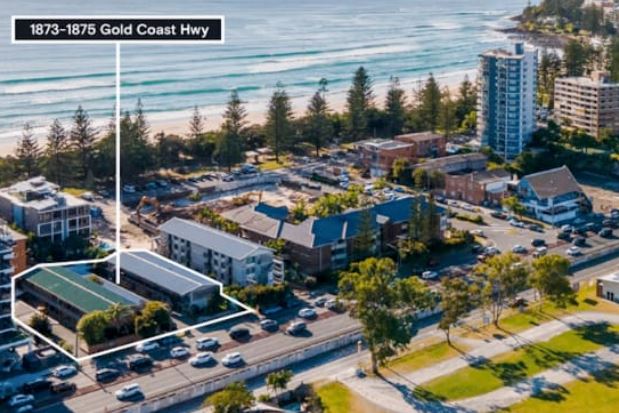
The site amalgamation specialists GV Property Group are anticipating major local demand for a 2,024 sqm site at 1873-1875 Gold Coast Highway, Burleigh Heads.

It’s set on the sought-after beachside of the highway, meaning any potential development will likely enter from the highway, but would be oriented to the face the quieter beach.

There’s a 53 metre height limit, around 17 levels. There’s currently two apartment blocks, with 16 apartments. The site is for sale via expression of interest closing 14th October.

GV Property Group’s Antonio Mercuri said the amalgamation process has allowed this double block with a 40m frontage the opportunity to be redeveloped into high-rise apartments or a hotel or short stay accommodation.

“This collective sale of 16 individually owned apartments has scope to turn into 60+ and more new apartments located in the heart of the southern Gold Coast,” Mercuri says.

“The location provides depth in all areas of the market from first home buyers, investors, down-sizers, weekenders and owner-occupiers.”

developers

Carly Cottam, who heads the boutique sales and marketing agent MOTIV, says the site lends itself to a development of apartments starting from larger one-bedroom plus media room apartments all the way through to four-bedroom apartments.

Cottam says there should an emphasis on curated ground and rooftop amenity to compliment the lifestyle Burleigh Heads offers residents and visitors.

Cottam adds that across the South East Queensland market, in particular in lifestyle markets like Burleigh Heads, she has seen a real surge in owner-occupier demand, although more recently there’s been increased demand from sophisticated investors.

“Both buyer profiles are seeking larger liveable residences, quality, and connection to lifestyle amenities,” Cottam says.

She says that the site is located in an extremely desirable location, with immediate access to The Esplanade and within walking distance to lifestyle amenities including James Street, Burleigh Head National Park and the upcoming Light Rail.

Todd Matheson, associate director at KMSM, said that Burleigh Heads continues to see incredible uptake of any project released to market with a drive to boutique buildings offering larger apartments aimed at owner occupiers looking for liveable apartments, close to lifestyle amenity including cafes, restaurants, beaches and shopping.

“For this location, we would recommend a combination of smaller two bedroom and three bedroom apartments with roof top amenity allowing for the low floors with limited views to utilise the roof top to entertain and take advantage of views.

“Overall, the site is located in arguably the most desired suburb on the Gold Coast and close to Burleigh’s centre allowing an emphasis of walkability to all the amenity yet far enough away for peace and quiet.

“Depending on finishes and the final breakdown of a project, we are confident in achieving sales rate of $9,000 to $11,000 in this current market, with possible uplift to $12,000 even $12,500 for the highest levels.


Article Source: www.urban.com.au


from Queensland Property Investor https://ift.tt/3m3EM4u
via IFTTT

New Real Estate Listings Lift Across Nation

Freshly-listed housing stock is starting to lift as the spring selling season begins to heat up.

Every Australian capital city has seen a lift in the number of new real estate listings over recent weeks, with some of the largest listing increases recorded in those capitals navigating lockdown.

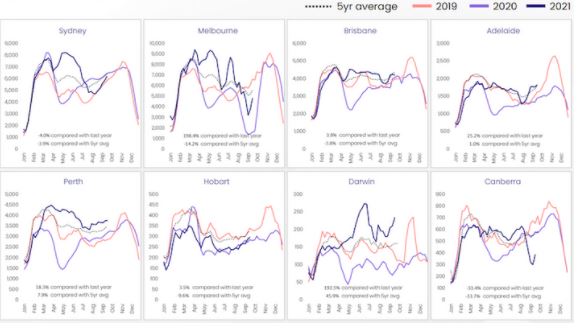
Despite this, the new listings trends remain below the five-year average in every capital apart from Adelaide, Perth and Darwin.

Nationally, new listings bottomed out over the four weeks ending September 5 with just 31,731 new listings added to the market, the lowest volume since the seasonal low in January this year.

While new listings have since lifted by 9.8 per cent, the number of new listings is currently—21.6 per cent lower than the recent high in March and -3.9 per cent below the five-year average for this time of year.

New listing trend relative to previous years,
rolling four-week count 

Real Estate Listings

^ Source: Corelogic 

The largest lift in new listing numbers has been in Melbourne, where the rolling four-week count reached a recent low in the first week of September when only 3230 new listings were added to the market.

Since then, the trend in new listings has surged 48.5 per cent.

Recently eased restrictions on property inspections will have added to the lift in new listings, however there was already upwards movement prior to the announcement on September 17.

Figures show Melbourne’s new listings trends have been extremely volatile, falling sharply through each of the five lockdowns to-date, before rebounding quickly once restrictions were lifted.

Sydney hasn’t shown the same volatility as Melbourne; partly due to fewer lockdowns, but also because restrictions did not prohibit private one-on-one inspections.

As a result, the rolling four-week count of new listings has steadily risen since mid-August. Based on the count of new listings as at September 19, freshly advertised listings are up 31 per cent, but remain -3.9 per cent below the five-year average for this time of the year.

In Canberra, where residents are also navigating an extended period of lockdown, the new listings trend has increased by 28 per cent since finding a low last week.

Up until midnight on September 17, physical property inspections were prohibited in Canberra. With these rules now eased, it’s likely the new listings trend will ramp up more substantially.

At the opposite end of the spectrum are the cities that have mostly avoided lockdowns.

In Perth, the new listings trend is tracking 7.9 per cent above the five-year average and up 18.3 per ecent compared to the same period last year.

Darwin listings are rapidly trending higher—45.9 per cent above the five-year average,

while Adelaide’s new listings trend is 1 per cent above average.

Brisbane’s new listings trend was suffering from a lockdown hangover, which had dragged the rolling four-week count of listings lower.

While the hangover appears to be lifting, the upwards shift is mild and the count of new listings remains -3.8 per cent below the five-year average.

The new listings trend in Hobart has held consistently below average levels throughout 2021, which is likely a key contributing factor to the rapid rate of appreciation in housing values -up 24.5 per cent during the past 12 months and the highest annual growth rate of any capital city.

The new listings trend is ramping up but remained -9.6 per cent below the five-year average over the four weeks ending September 19.

New listing trend relative to previous years 

Real Estate Listings

^ Source: Corelogic 

An increase in fresh listings will be a welcome relief for real estate professionals and prospective buyers.

However, total active listings remain -29 per cent below the five year average nationally; a symptom of the soft new listings flow, and the rapid rate of absorption due to above average levels of buying activity.

More listings imply buyers will have more choice, which theoretically should help alleviate some of the urgency in the market.

With lockdown restrictions planned to ease further as vaccination targets are met, we should see an increase in confidence from vendors thinking of selling their property.

At the moment, selling conditions remain skewed towards vendors rather than buyers, but a lift in listings through spring and summer should help to rebalance buyers and sellers’ places at the negotiating table.

By how much will depend on stock levels as well as the depth of buyer demand amid worsening affordability challenges.


Article Source: www.theurbandeveloper.com


from Queensland Property Investor https://ift.tt/3m4HoPp
via IFTTT

Australian Unity Tips $30m into SDA Fund

Wealth and investment platform Australian Unity is ramping up its specialist disability housing portfolio, tipping a $30.5-million raise into its newly established specialist disability accommodation fund.

Since opening the fund to investors 18 months ago, Australian Unity has grown its “participant-centric” SDA assets across the eastern seaboard to more than $50 million in assets.

Australian Unity seeded the fund with 33 specialist disability accommodation apartments and five carers’ apartments in Melbourne’s eastern and northern suburbs after a ​​first-round capital raise drew $39 million in investment.

Australian Ethical, an initial investor in fund, will again act as a cornerstone participant in the raise.

The group is banking on recent rising demand for the niche asset class, which has grown from nothing into a $2.5-billion asset class in the past five years.

Housing in the sector is specially developed for people living with a disability, with rental streams backed by the National Disability Insurance Scheme.

Industry forecasts are expecting the creation of a $10-billion asset class with an estimated $700 million to be spent annually on SDA payments as part of the NDIS, unlocking an enormous opportunity for the private sector.

​​Users of supported independent living are also expected to lift by 35 per cent from 26,000 to 35,000 during the next four years, according to a market statement released by the National Disability Insurance Agency in August.

Australian Unity social infrastructure general manager Ryan Banting said the fund was a critical component of the group’s broader commitment to social infrastructure assets, including hospitals, medical centres, aged care and student accommodation.

The group’s existing social infrastructure portfolio includes Brisbane’s $1.1-billion Herston Quarter redevelopment, along with its investments in hospitals, medical centres and seniors living facilities across the country.

“Across the property market, few growth opportunities have matched that of Australia’s disability housing sector, which during the past five years has emerged from the ground-up to reach $2.5 billion,” Banting said.

“The attraction is reflective of the sector’s risk appropriate yields and the opportunity to make a measurable difference to the lives of Australians living with disability.”

As well as Australian Unity, Macquarie, Lighthouse Infrastructure and ASX-listed Arena REIT are all early movers in the sector.

Already Summer Housing has raised more than $300 million from a variety of sources, with 370 dwellings financed.


Article Source: www.theurbandeveloper.com


from Queensland Property Investor https://ift.tt/3uuZ4Yx
via IFTTT

Fears Wharf Strikes Will Bring Construction to its Knees

The construction industry has been dealt another blow as industrial action cripples ports across Australia, adding pressure to an already constrained construction materials supply chain.

The Maritime Union of Australia has launched strike action at Patricks Wharfs at Sydney, Melbourne, Brisbane and Fremantle, in a campaign for pay rises and increased union control of manning levels and hiring.

Port Botany wharfies in Sydney will strike next weekend, while Melbourne wharfies plan to strike every second day in October.

Master Builders Australia chief executive Denita Wawn has condemned the industrial action, which she said would paralyse the industry.

“More than $10 billion in building products was imported in the past 12 months and these strikes will hammer the building supply chain which is already under huge pressure,” Wawn said.

“Our members are already experiencing long delays and substantial cost increases due to product shortages and these strikes will make it even harder for building and construction businesses across the country.

“There’s absolutely no doubt these strikes risk hurting the recovery from Covid as governments around the country are harnessing the building industry’s economic multiplier effect to accelerate economic activity and growth.”

Container ships have been waiting up to 18 days at berth in Sydney as a result of the industrial action while negotiations have stalemated once more.

 construction

▲ Freight times on construction materials will be pushed out as ships sit in berth for up to 18 days during industrial action. 

The property industry has underpinned Australia’s Covid-19 economic recovery and produces about 13 per cent of the nation’s gross domestic product.

It has been grappling with steel and timber shortages as a result of global supply chain issues and the tailwinds of the HomeBuilder stimulus package fuelling a construction boom.

According to the Housing Industry Association, 82 per cent of builders are reporting delays with supply or trade, and there is about a 15-week lead time on timber trusses and frames, but this could blow out significantly with port industrial action.

Patrick Terminals chief executive Michael Jovic said the company had been in negotiations with the Maritime Union of Australia since February 2020, and they had an offer on the table for a 2.5 per cent pay rise over the next four years.

The ongoing industrial dispute has reportedly cost Patrick Terminals more than $15 million in revenue, which the union has rejected, while impacting supply chains across the country.

Wharf industrial action was also brought to the Fair Work Commission at this time last year, where claims were made it was delaying supply chains by up to three weeks.

But supply chain disruptions to the construction industry are likely to persist beyond the middle of 2022, according to a global risk survey released recently.

The Oxford Economics survey found one in eight businesses surveyed this month said they had been “severely affected” by supply chain interruptions, and half of respondents said they expected the Delta outbreaks to affect their businesses well into next year.

The Property Council of Australia said labour and material shortages driving up the cost of construction jobs and disruptions caused by the pandemic had delayed projects. Material shortages are at their worst in four decades.

The Australian Competition and Consumer Commission is already investigating reports of price gouging in the shipping industry, and is due to release its annual stevedoring monitoring report in November.


Article Source: www.theurbandeveloper.com


from Queensland Property Investor https://ift.tt/3AMKtcZ
via IFTTT

Homebuilders Make Apartment Development Shift

Brisbane builder-cum-developer Graya has acquired a boutique site in the inner-eastern suburb of Bulimba as it makes the transition from homebuilder to apartment developer.

The project is a collaboration with local architect Bureau Proberts and is the second apartment development for Graya after “Maison” in New Farm, which is close to completion.

In this TUD+ Briefing, managing director Rob Gray takes us through the new project and Graya’s broader plans.

Gray said the Bulimba development, Canvas, was part of Graya’s philosophy of sticking to the best suburbs in Brisbane.

“Bulimba really stood out to us was one of those suburbs that is very desirable to live in,” he said.

“The exciting part about this project is that predominately the Graya product is unaffordable to most people, but as this project transpired, while it is still high-end, because we would never not do high-end, it is an affordable product.

“So, for the first time, we can really appeal to some classes of investors … we’re really looking forward to dabbling in that market.”


Article Source: www.theurbandeveloper.com


from Queensland Property Investor https://ift.tt/3AMKsWt
via IFTTT

QLD island property listed for less than house in parts of Logan

This spectacular island property off Far North Queensland has two houses, a beach hut and views to rival the Maldives. But this one w...